Similarweb's 2026 Generative AI Brand Visibility Index opens with a direct claim: the link between offline brand demand and search visibility, the old assumption that market share buys digital shelf space, is broken in beauty. Generative AI search engines act as trusted curators. They prioritise informational depth and authority over how big a brand's transactional footprint is.
That's exactly why beauty is one of the categories we're pressure-testing first with @By Yuliya Fragrances, Obsessd's newest launch partner; a fragrance brand built in Australia on its unique ingredients story and formulation, not shelf presence. Beauty is where offline brand equity and AI visibility should, in theory, move together. The data says they don't.
The beauty gap, in numbers
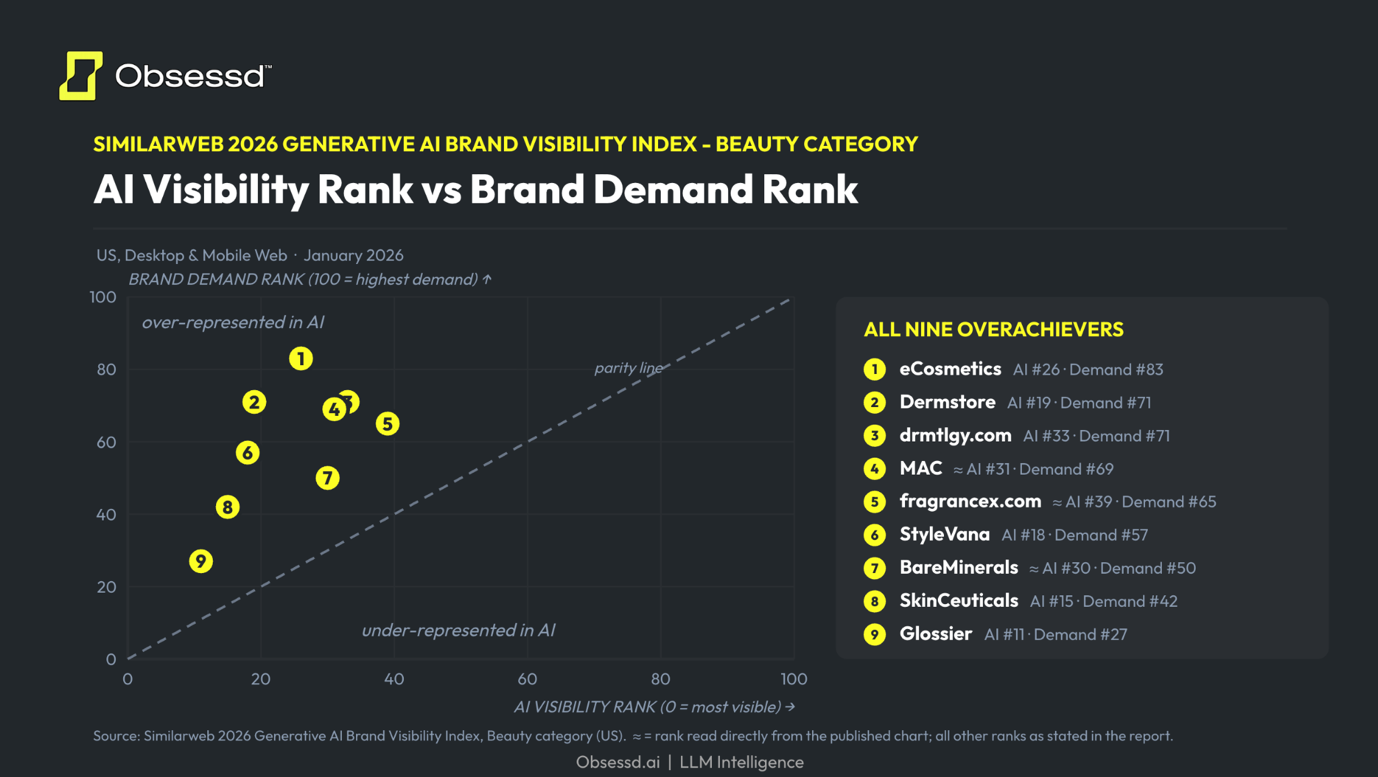
The index compares two rankings for the same brand: where it sits on traditional brand demand, and where it sits on AI visibility. When the two match, a brand sits on the parity line. Nine specialist, mid-tier, and prestige players don't.
eCosmetics holds an AI Visibility Rank of #26, well ahead of its Brand Demand Rank of #83. Dermstore is #19 in AI visibility against #71 in demand. drmtlgy.com is #33 against #71. StyleVana is #18 against #57. SkinCeuticals is #15 against #42. Glossier is #11 against #27. MAC, fragrancex.com and BareMinerals sit in the same territory too, at roughly #31 against #69, #39 against #65, and #30 against #50, read directly off the published chart rather than stated as exact figures in the report text.
Every one of them is more visible inside AI search than their offline demand would predict. Not slightly. Multiples.
Why the AI layer doesn't care about your ad spend
The mechanism is consistent across all nine, and it isn't paid media. It's content architecture.
These brands write about formulation the way a chemist would, not the way a copywriter would. Concentration percentages, pH levels, chemical stability, what an ingredient is formulated to do and for whom. They build step-by-step routines instead of standalone product pages, answering the layering questions people actually ask an AI assistant, such as how to sequence Vitamin C, hyaluronic acid and sunscreen without one cancelling the other out. And they write troubleshooting content that defines a skin concern, explains the cause, and sets a realistic timeline, rather than pitching a product against it.
The AI layer doesn't score how much a brand spent building awareness. It surfaces what it can read, what it trusts, and what has been structured to answer the question in front of it. A well-known name with persuasive brand copy and a smaller name with a precise ingredient dictionary are not competing on the same terms once the query moves into an AI assistant. Depth of explanation is doing the work that pure budget used to do.
The Australian catch
The Similarweb index is US desktop and mobile web data (January 2026). It is not an Australian reading, so we won't pretend it is.
What travels is the mechanism, not the number. An AI assistant set to Australia pulls different sources, surfaces different competitors, and frames categories differently to one set to the US. A brand that would rank as an overachiever on US data may not hold the same position once the same prompts are run with an AU locale, and the reverse is also true. The only way to know where an Australian beauty brand actually sits is to run the audit locally, not import someone else's index and assume it carries over. A point we believe carries weight.
The beauty brand playbook, mapped for AU execution
The report names three pillars overachieving brands build around: formulations, routines, and skin concerns. We've mapped each one into a working content structure below:
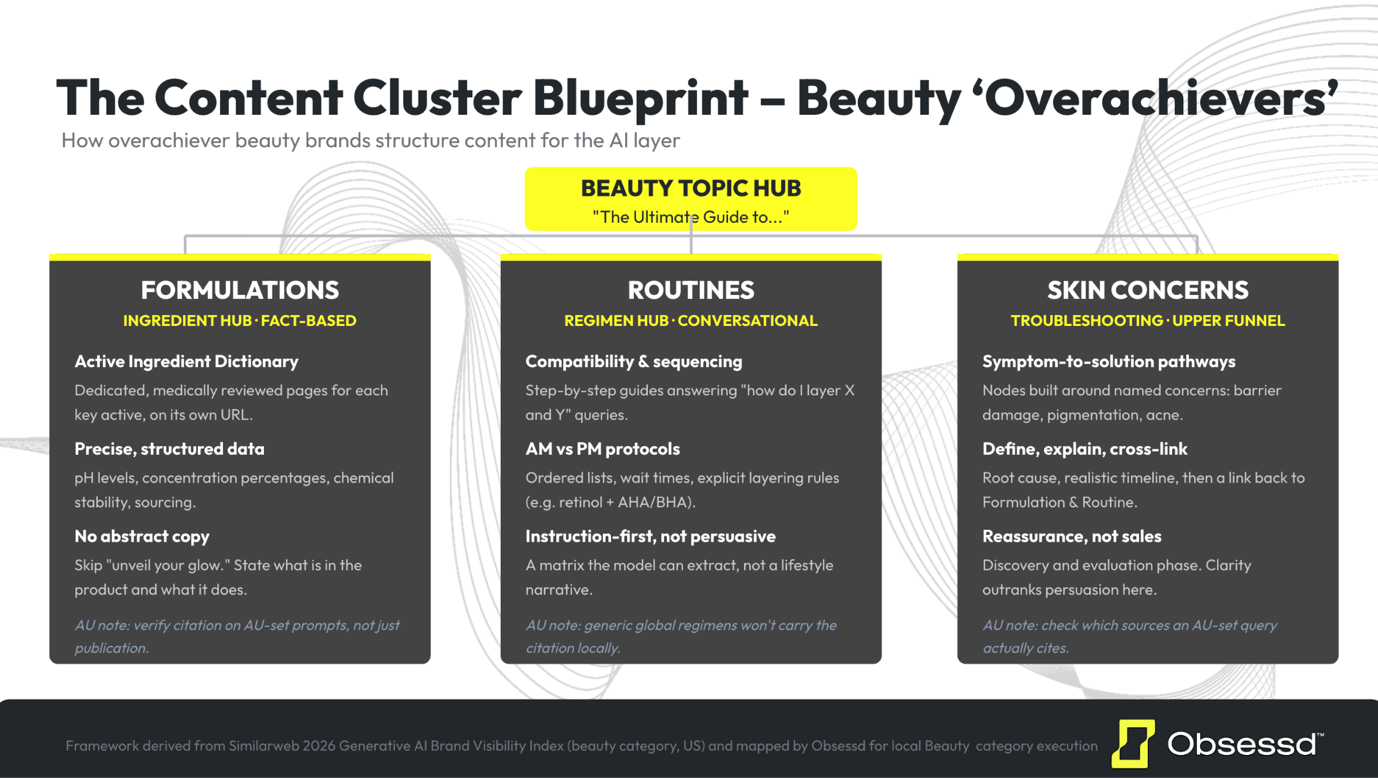
The short version: build a factual ingredient dictionary instead of abstract product copy. Build sequencing and compatibility guides instead of isolated product pages. Build symptom-to-solution content for named concerns instead of assuming the reader already knows your brand. Each pillar should cross-link back to the others, so the model can move between them the way a customer's questions actually move.
AI tools are already rated most useful by consumers in the discovery and evaluation phases of a purchase, at 35.0% and 32.9% respectively. This is upper-funnel work. It is where a category decision gets made before a brand is ever searched by name.
Where this leaves a beauty challenger brand
You do not need Ulta's budget or Sephora's traffic to hold ground here. You need a formulation page that reads like a fact sheet, a routine that answers the layering question before it's asked, and a concern page that treats the reader as someone who wants a clear answer, not a pitch.
That is a genuinely different competitive dynamic to the one most Australian beauty marketing teams have been playing under. If you want to know where your brand actually sits against this shift, on AU-set prompts, not global ones, that's the audit we run.
Source: Similarweb 2026 Generative AI Brand Visibility Index, Beauty category (US), January 2026.